The Employment Rights Act 2025 represents one of the most significant shifts in employment law for a generation. While much of the conversation has centred around legal compliance, the bigger challenge for many organisations will be its effect on the work environment.
Employment legislation does not just change processes. It changes behaviours, expectations and the relationship between employers and employees.
The real test for organisations will not be the legislation itself, but how they respond to it. The organisations that listen, act and lead with clarity will not just manage the change; they will build stronger, more trusted cultures.
Employment Rights Act 2025: The biggest concerns for organisations
The scale of change under the Employment Rights Act 2025 is significant. However, our recent webinar poll highlighted that organisations are not only concerned about compliance, but the practical and cultural impact these changes could have on their workplaces.
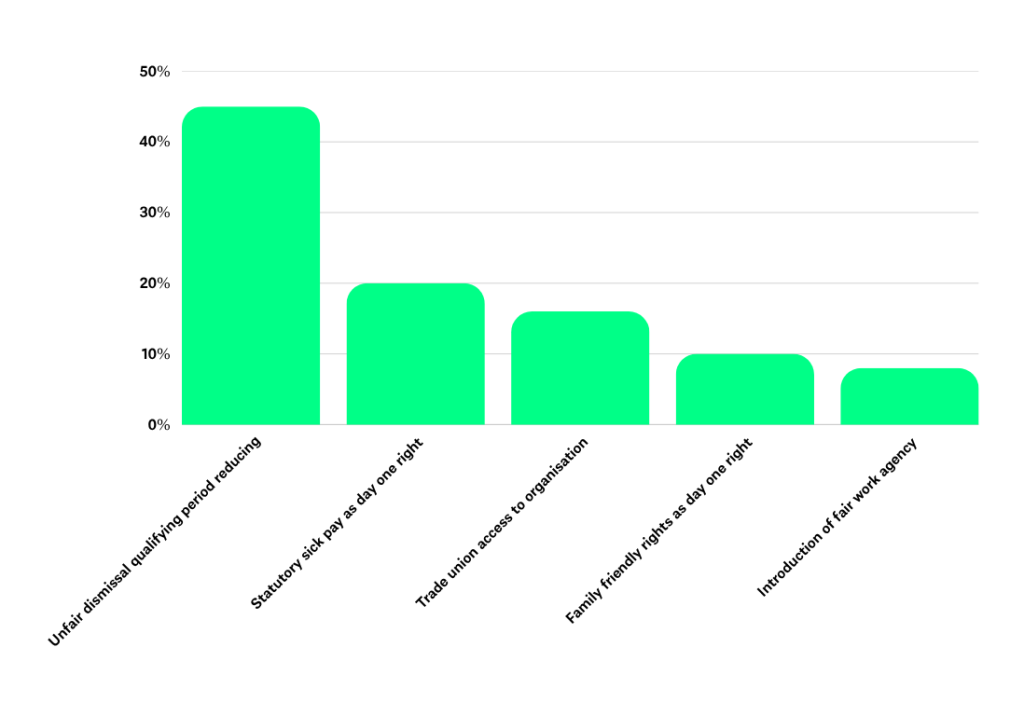
When asked about their biggest concerns, 45% of respondents identified the reduction of the unfair dismissal qualifying period from two years to six months as their primary concern. This was followed by day-one statutory sick pay rights (20%) and increased trade union access to organisations (16%).
The findings reveal a common theme: organisations are concerned about how new employment rights may influence behaviours, management practices and employee relationships.
The challenge is not to resist these changes. It is to ensure their organisation responds in a way that protects trust, maintains fairness and strengthens the work environment.
How organisations can prepare their work environment for the Employment Rights Act 2025
1. Unfair dismissal changes: avoiding a “hire slow, fire fast” culture
The reduction in the unfair dismissal qualifying period is one of the biggest concerns for organisations. While the intention is to increase employee protection, organisations must be careful that this does not unintentionally create a “hire slow, fire fast” mindset.
Without the right approach, businesses could see:
- Less willingness to recruit higher-risk or non-traditional candidates
- Greater scrutiny during the first months of employment
- Reduced patience for learning curves and settling-in periods
- More transactional employment relationships and a reduction in trust and loyalty
The answer is not to become more cautious. It is to respond differently.
Organisations should focus on strengthening manager capability, creating supportive probation processes and ensuring documentation supports effective conversations rather than replacing them.
The most successful organisations will redefine probation as a period of support, development and clarity, rather than simply a period of assessment.
2. Day-one statutory sick pay: creating a culture of trust and accountability
Changes to statutory sick pay have the potential to alter behavioural signals around absence. When organisations change the conditions around absence, they may see a greater need for consistent management approaches.
The challenge is finding the right balance between creating a culture of trust and maintaining accountability.
The goal should not be to control absence. It should be to create the right conditions where positive behaviours naturally happen.
Organisations can achieve this by:
- Setting clear expectations around attendance and well-being.
- Equipping managers to have open and honest conversations.
- Looking for patterns rather than isolated incidents.
- Maintaining consistency across teams.
- Creating a support-first approach to absence management.
3. Trade union access and employee voice: building a culture where people feel heard
Enhanced trade union access represents more than a procedural change. It reflects a wider shift in employee voice and influence.
For many organisations, particularly in the private sector, the biggest question is whether employees already feel heard.
Businesses that invest in strong communication, transparent leadership and meaningful employee feedback channels will be better prepared for the changes ahead.
Organisations should focus on:
- Strengthening existing employee voice mechanisms
- Creating forums for open and honest dialogue
- Building leaders who are comfortable listening and responding
- Addressing concerns early before they escalate
- Creating trust through greater transparency
Where people feel heard and issues are addressed early, the need for external intervention naturally reduces.
Is the Employment Rights Act 2025 more than a compliance challenge?
The Employment Rights Act 2025 is accelerating risk much earlier in the employee lifecycle and changing the signals that influence employee and management behaviour.
This means organisations cannot rely on policies alone.
The businesses that will adapt most successfully are those that invest in their managers, create consistency, build trust and make employee voice part of everyday culture.
The legislation may be the catalyst for change, but leadership will determine the outcome.
What the Employment Rights Act 2025 Means for Employers
The most successful organisations will not be those that simply react to legislative changes. They will be those that use this moment as an opportunity to strengthen their culture.
By investing in leadership capability, improving employee relationships and creating clear expectations, organisations can turn potential challenges into opportunities to build a more resilient work environment.
The Employment Rights Act 2025 should not be viewed purely as a legal obligation. It is a catalyst for organisations to reflect on how they recruit, support, manage and engage their people.
How can AAB help?
Preparing for the Employment Rights Act 2025 is about more than updating policies and procedures. It requires organisations to consider how they lead people, manage performance, support employee wellbeing and create environments built on trust.
At AAB, we help organisations move beyond compliance and take a proactive approach to the changes ahead.
Our People team specialists can support with:
- Reviewing HR policies, procedures and employee documentation to ensure they remain fit for purpose.
- Strengthening managers’ capability and confidence in having effective conversations.
- Reviewing recruitment, onboarding and probation processes to support fair and inclusive hiring.
- Developing practical approaches to absence management that balance support, consistency and accountability.
- Enhancing employee voice, communication channels and leadership behaviours.
- Identifying potential cultural risks before they become employee relations challenges.
The organisations that will adapt most successfully will be those that prepare early. By investing in their people, processes and leadership capability now, businesses can reduce risk and build stronger, more resilient workplace cultures for the future.
Whether your organisation needs support preparing for specific Employment Rights Act 2025 changes or it wants to understand the wider impact on its work environment, our People Services specialists are here to help. Please do not hesitate to get in contact with Louise McCosh, a member of our People team, or your usual AAB contact.
How AAB can help
People
AAB People is all about helping businesses get the best out of their people. Whether you're growing fast, facing change, or need extra support, their team steps in with practical, no-fuss solutions.
They offer hands-on help across HR, employment law, health & safety, learning & development, organisational culture, and whistleblowing. From writing contracts to managing risk, coaching leaders or boosting team engagement, they’ve got it covered.
What makes them different? They don’t just advise from the sidelines. AAB People works as part of your team - understanding your business inside out and shaping support around your goals. No off-the-shelf fixes. Just smart, tailored advice that fits your world.
With experts based across the UK, AAB People support hundreds of clients, from start-ups to large organisations. They believe happy, healthy, and well-supported teams are the key to business success - and they’re here to make that happen.
View our People service