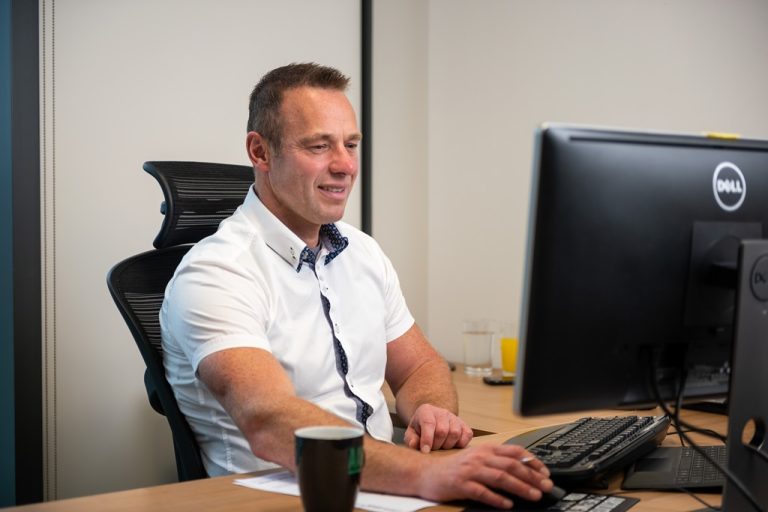
AAB's private client tax team deliver clear advice in understandable terms so we can appreciate how effective planning can lead to benefits for the whole family. They have taken away the worry and doubt for us.
Alex Wiseman

Setting up and running a business can be exciting and will almost certainly entail a great deal of hard work and long hours, so it’s only right that you should be able to reward yourself appropriately. Our personal tax accountants can provide the tax advice you need to carefully plan how to avoid paying unnecessary amounts of tax.
We give tax advice to business owners on personal tax using our experience and knowledge to help create the most efficient tax strategy for your individual situation. The most commonly used methods to extract profit are taking a salary, taking a dividend and paying into a pension. We’ll examine them here.

Assuming your business vehicle is a limited company, you can pay yourself a salary. A salary is regarded as an allowable business expense, so it will reduce the amount of Corporation Tax your business is liable for.
Additionally, if you decide to take a salary above the Lower Earnings Limit (£6,396 for the 2022/23 tax year) then it will count towards your state pension contributions. It might be tempting to pay yourself a significant amount, but there are good reasons for being restrained. If your salary is below the National Insurance (NI) Primary threshold, you won’t need to pay employee’s NI contributions and if it’s below the NI Secondary threshold, your company won’t have to pay employer’s NICs.
A point to think about regarding NI contributions is that the threshold is monthly rather than annual, so if your income for one month exceeds the threshold, you’ll pay NICs even if your income is below the threshold for all the other months.
Another point to be aware of, is that if you’re a director rather than an employee, then the threshold is annual rather than monthly and is calculated at the weekly amount x 52.
Keeping your salary below the Personal Allowance (£12,750 for the 2022/23 tax year) will also mean you don’t pay any income tax (provided you don’t have other income that could take you over the limit).
This may seem a poor return for all your hard work, but bear in mind that a higher salary will reduce your company’s profits, which in turn reduces the value of dividends you can pay to yourself as a shareholder. It’s all about balance, and we can do the sums for you to arrive at the most tax-optimal figure.
Paying into a personal pension is another popular way to extract profits from your company. As a director your limited company can make pension contributions for you as an employee; it counts as a business expense so it’s deductible against Corporation Tax. So you benefit by putting money aside for the future and reduce the company’s tax bill.
You can also, in theory, pay into your pension as an individual. However, that has no impact on your company’s profits and therefore won’t reduce Corporation Tax, so it’s more tax-efficient for your company to make the payments.
You’ll get tax relief on your pension contributions, up to your annual allowance, which is 100% of your earnings, or £40,000 – whichever is lower. Above that allowance, the contributions will be subject to income tax, but at a lower rate than you’d pay on your salary.
Although you can keep putting money into your pension over the years, there’s a limit on how much you can take out, either in lump sums or a regular income, before you start paying tax on it. This is your lifetime allowance, which is currently £1,073,000.

A dividend is a share of the company’s profits, and as the company owner and a shareholder, you can pay yourself a dividend. The benefit here is that there’s less tax to pay on dividends than on income. It’s usual to take a mix of salary and dividends to ensure you pay the least possible tax.
If you have an annual dividend allowance of £2,000, which is tax-free, then dividends are taxed at 7.5% for basic rate earners and 32.5% for higher rate earners. At the additional rate for those earning over £150,000, the dividend tax rate is 38.1%. Dividends are exempt from NIC.
You can only pay yourself a dividend if there’s sufficient profit in the company to cover it. Remember, profit is what remains after all the business expenses have been paid, including Corporation Tax and VAT. Should you have sufficient profit but decide not to pay dividends one year, then the profit accumulates, so you can potentially pay larger dividends in the future.

AAB's private client tax team deliver clear advice in understandable terms so we can appreciate how effective planning can lead to benefits for the whole family. They have taken away the worry and doubt for us.
Alex Wiseman
Following many years living and working overseas, returning to the UK raised several complex tax considerations for both my wife and me. The Private Client International Tax Team at AAB guided us through every aspect of our UK re‑entry with clarity and confidence, from confirming our UK tax residence position to explaining how UK tax applies to our income and gains going forward.
David Mendelson
I wouldn’t hesitate in recommending AAB to anyone else who, like us, may be struggling to get the expert advice required, especially when it involves coming back to the UK and managing tax aspects on overseas income and assets.
John Bannerman

From April 2027 Inheritance Tax and Pension changes are coming that mean unused pension funds and…
The UK Autumn Budget 2026 is on the 28th October, and with it the buzz of…

The inheritance tax (IHT) changes to Business Relief (BR) and Agricultural Relief (AR) announced in the…






We help businesses at every stage of their lifecycle manage their people and finances, using technical innovation to maximise efficiency and value. We serve a global portfolio of SME and large corporate clients across twelve key sectors.
Specialist support is also available for family businesses and individuals. Our passionate team is our greatest strength, operating with a culture driven by a genuine commitment to client success. AAB operates from offices in the UK, Ireland, and Internationally.
How can we help? Share a few details and we’ll get back to you within one working day.
Other services that work hand-in-hand with this one.