April 2027 Inheritance Tax and Pension changes: What to know
From April 2027 Inheritance Tax and Pension changes are coming that mean unused pension funds and many death benefits will be brought into the IHT net for the first time. For years, pensions have been one of the most tax-efficient ways to pass wealth to the next generation. Any unused pension pot could be inherited free of Inheritance Tax (IHT), making pensions a popular tool not just for retirement income, but for estate planning too. That’s about to change.
Combined with restrictions to Business Relief and Agricultural Relief that came into effect in April 2026, families with significant pension wealth, trading businesses or farmland are facing a materially different tax landscape, and in some cases, a significantly higher IHT bill.
In this article, we discuss the changes coming to Inheritance Tax, who it affects, some examples of the impact of the changes and what you can do now to prepare.
We recently covered these changes in our April 2027 changes to Inheritance Tax and Pensions webinar. If you missed the webinar, you can still catch up now on demand.
What to know about the April 2027 Inheritance Tax and Pension changes
Inheritance Tax Changes: A recap
Before looking at what’s new, it’s worth reminding ourselves of the basics:
- IHT is charged at 40% when someone dies, and can also apply to certain lifetime gifts at 20%.
- Everyone has a Nil Rate Band (NRB) of £325,000, which is exempt from IHT.
- Transfers between spouses are generally exempt, both in life and on death, and an unused NRB can pass to a surviving spouse, giving married couples up to £650,000 before any IHT is due.
- On top of the NRB, individuals may also qualify for the Residence Nil Rate Band (RNRB) of £175,000, provided a qualifying property is left to children, grandchildren or other lineal descendants and the total estate doesn’t exceed £2 million (relief tapers away above this). Like the NRB, an unused RNRB can pass to a surviving spouse, taking a married couple’s potential IHT-free allowance to £1 million, worth up to £140,000 in tax savings.
- Reliefs exist for qualifying businesses and agricultural land (Business Relief and Agricultural Relief), which can allow those interests to pass free of IHT, though as we’ll see below, this relief is now capped.
- Gifting assets during your lifetime remains a valid way to reduce IHT exposure, provided you survive seven years from the date of the gift and retain no ongoing benefit from what you’ve given away.
What changed in April 2026: Business and Agricultural Relief
Until April 2026, Business and Agricultural Relief had no upper limit, meaning a qualifying trading business or farm of any size could pass to the next generation completely free of IHT.
That’s no longer the case. From April 2026:
- 100% relief is capped at £2.5 million of qualifying asset value per person.
- Above that threshold, only 50% relief is available.
- This creates an effective IHT rate of 20% on the value of a business or farm above £2.5 million, per person.
- Any IHT due on qualifying assets can still be paid in interest-free instalments over 10 years.
- To qualify for Business Relief, the business must be a genuine trading business, and there can be restrictions where a business holds significant non-trading assets or surplus cash. Agricultural Relief can extend to farmland let to another farmer.
For business owners and farming families with assets above the £2.5 million threshold, this is a significant shift from a position of potentially unlimited relief to one with a real, calculable tax cost.
April 2027 inheritance tax and pension changes:
A further change on the horizon relates to pensions. Currently, unused pension pots can generally be inherited with no IHT due at all. From April 2027, the position changes.
Key points:
- Unused pension funds and many pension death benefits will be included in the IHT calculation on death.
- This will affect anyone who dies holding unused pension benefits – which, for many people who have built up pension wealth precisely because it sat outside their estate, could be a significant number.
- Spousal exemption may still apply, meaning the practical impact will generally fall on the second death rather than the first.
- Where pension funds are drawn down after the pension holder’s death and the holder dies aged 75 or over, the beneficiary may also face income tax of up to 45% (up to 48% for Scottish-resident beneficiaries) on top of the 40% IHT charge.
- Taken together, this can produce an effective combined tax rate of around 67% on inherited pension wealth, and as high as 91% in cases where the Residence Nil Rate Band is lost as a result of the pension value pushing the estate over the £2 million taper threshold. The effective rate can be higher still in Scotland.
- Administering estates that include pension assets will also become more complex, more time-consuming, and more costly, since pension scheme administrators and personal representatives will need to work together to calculate and account for the IHT due.
Bringing the inheritance tax changes to life: three example case studies
| Case study | Circumstances | IHT before change | IHT from 6 April 2027 | Increase | Key impact |
| Mrs Alas | Widow with £2m of non-pension assets and an unused pension pot of £700,000 | £400,000 | £820,000 | £420,000 | The pension is subject to IHT and income tax of up to 45%. Of the £700,000 pension, only around £60,670 would ultimately reach beneficiaries. |
| Mrs Smith | Inherited a £10m trading business, £1m of other assets and a £1m pension | £140,000 | £1.54m | £1.40m | Instalment payments may help with cashflow on the business element, but the size of the liability raises questions over how the balance will be funded. |
| Mr Jones | Widower with a £5m trading business, including £1m excess cash, £1m of other assets and a SIPP holding the trading premises | £540,000 | £940,000 | £400,000 | The SIPP will be included in the IHT calculation and subjected to IHT at 40%. Questions arise as to how the SIPP’s proportion of the liability will be funded given it’s only asset is the trading premises of the business. |
With some planning (for example, having the company purchase the trading premises from the SIPP so there’s no surplus cash held in the business), the £5 million of qualifying business assets can attract full relief, bringing the IHT bill back down to £540,000: a saving of £400,000. The pension would then hold cash rather than illiquid property, giving it the liquidity to fund its share of any IHT due.
These examples show how the changes interact, and in particular how pension values, business structure, and the RNRB taper can all affect each other, sometimes in ways that aren’t obvious until the numbers are run.
What could April 2027 Inheritance Tax and Pension changes mean for you?
You’re likely to be affected by these changes if:
- You or your spouse hold significant personal or pension wealth.
- You own a trading business or farmland.
- You have a property rental business, particularly one held in a company.
- Your business premises are held within a SIPP or SSAS.
- Your business holds surplus cash.
What you can do next to prepare for the Inheritance Tax changes
The good news is that there’s still time to plan before the April 2027 Inheritance Tax and Pension changes take effect, and the case studies above show that thoughtful restructuring can make a meaningful difference to the eventual tax bill.
AAB’s Private Client advisory team can help you:
- Review your IHT position and quantify your potential exposure under the new rules.
- Restructure assets and Wills to make the most of available reliefs, and advise on wider IHT mitigation opportunities.
We can also co-ordinate tax, wealth and legal advice on your behalf, so you only need one point of contact to get the full picture.
To talk through how these changes might affect you or your family, get in touch with Steve Roberts, Tom Andrew, or a member of our Private Client team.
Looking ahead to the UK Autumn Budget 2026: Everything individuals need to consider
The UK Autumn Budget 2026 is on the 28th October, and with it the buzz of questions is already in full swing from families, business owners and investors: Will Inheritance Tax change again? Are pensions really going to form part of your taxable estate? Is it time to sell, gift or restructure?
No one can foresee what will be announced, but what we can do is separate the three things that matter: what is already settled, what is being speculated about, and what you can sensibly do now, whatever happens. In this article, we discuss 5 key things we believe individuals should consider ahead of the UK Autumn Budget 2026.
1. Inheritance Tax (IHT)
What we know
- The nil-rate band (£325,000) and residence nil-rate band (£175,000) remain frozen, so more estates are being drawn into IHT as asset values rise.
- The standard rate remains 40% on the value of an estate above available allowances.
- Social care funding is now firmly on the political agenda. At the Labour Party conference on 29 September, the Prime Minister announced plans for a National Care Service for England, to be funded in part by changes to the state pension triple lock from April 2030. The triple lock itself is unchanged for now, and the change would only take effect after the next general election.
- The announcement did not include a change to inheritance tax. Press reports of a flat 10% levy on all estates were met with a Government statement that there were “no plans for this”, and the Prime Minister’s speech did not introduce one.
- While the detail of the National Care Service remains to be developed, the announcement highlights the growing political focus on how long-term social care will be funded in the future.
What might happen
Further changes to thresholds, reliefs or lifetime gifting rules cannot be ruled out, particularly given pressure on public finances. At this stage, though, that is speculation rather than fact.
What you can do now
- Know your number. Work out your likely estate value, including pensions, property and business assets, and what IHT would be payable today.
- Review your Will and any trusts. Out-of-date documents can cost families more than any tax change.
- Start gifting conversations early. Regular gifts from surplus income, use of annual exemptions and larger lifetime gifts all work best when planned well ahead, as some gifts must be survived by seven years to fall outside the estate.
- Consider life assurance written in trust to help fund a future IHT bill outside the estate.
2. Pensions and IHT
What we know now
The Government’s plans to bring unused pension funds into the inheritance tax (IHT) net from April 2027 are moving closer to reality.
While the principle hasn’t changed, we now have much more clarity on how the rules will work in practice and, importantly, who will be responsible for paying the tax.
What will happen from April 2027?
Most unused pension funds and death benefits will form part of an individual’s estate for IHT purposes.
- Pensions left to a spouse or civil partner should continue to benefit from the spouse exemption.
- Pensions left to children or other beneficiaries could face IHT of up to 40%.
- In some cases, beneficiaries may also pay income tax when they draw the funds.
Following consultation, the Government has confirmed that executors, not pension schemes, will be responsible for reporting and paying any IHT due. Pension schemes will have four weeks to provide a valuation once notified of a death, and beneficiaries will ultimately share responsibility for any tax relating to benefits they receive.
The six-month deadline for paying IHT remains unchanged.
One positive development is that death-in-service benefits paid through registered pension schemes will remain outside the scope of IHT. This removes a concern that many employers and employees had following the original proposals.
What you can do now
For years, many people have treated their pension as the last asset to spend, preserving it for future generations. From April 2027, that strategy may no longer be the most tax-efficient.
That doesn’t mean everyone should start withdrawing pension funds. Far from it. But it does mean that pensions should now be reviewed as part of a wider estate planning strategy rather than viewed in isolation. We recommend:
- Reviewing whether your current drawdown strategy is still appropriate.
- Checking that your expression of wish forms are up to date.
- Making sure your executors know where all your pensions are held.
- Considering how any future IHT liability could be funded.
- Exploring whether gifting surplus pension income might form part of your planning.
Our overall message is not to panic. Although the administration of the new rules is still being refined, the direction of travel is clear. Some clients have asked whether the changes could be delayed or withdrawn. While the consultation altered the mechanics of the regime, the Government has repeatedly confirmed its intention to bring pensions within the IHT framework.
The key message is simple: don’t make rushed decisions, but don’t ignore the changes either. Now is a good time to review how pensions fit into your wider estate and succession planning arrangements.
3. Agricultural and Business Relief (AR/BR)
What we know
- From April 2026, 100% relief on qualifying agricultural and business assets is capped at £2.5 million per person, with 50% relief above that.
- Careful planning around ownership, spouse and civil partner transfers and succession can make a significant difference to how the cap applies.
What might happen
Farming and family business groups continue to press the Government for changes, and there has been speculation that the cap may be revisited. Nothing has been confirmed, and clients should not assume the rules will be reversed or softened.
What you can do now
- Value your assets properly. Many farms and family businesses are worth more than owners think, and a clear valuation is the foundation of any plan.
- Review ownership and structure. Who owns what, and in what proportions, affects how the cap is used between spouses and across generations.
- Plan succession early. Bringing the next generation into ownership gradually can reduce the shock of a future IHT bill.
- Consider liquidity. Many estates are rich in assets but short of cash. Think now about how any IHT liability would be funded without forcing a sale.
4. Capital Gains Tax (CGT)
What we know
- The main CGT rates are 18% and 24%, following changes made in October 2024.
- On death, assets currently receive a CGT uplift to market value. This means gains built up during a lifetime are not taxed when assets pass to beneficiaries.
What might happen
CGT is one of the most closely watched areas ahead of the Budget. Commentators have speculated about higher rates, alignment with Income Tax rates, changes to reliefs (in particular Business Asset Disposal Relief), or an end to the CGT uplift on death. None of this has been confirmed.
What you can do now
- Use your annual exempt amount each tax year, and consider using your spouse’s too.
- Think about the interaction with IHT. Gifting an asset can take it out of your estate but may trigger a CGT bill now, while holding it until death may expose it to IHT but wipe out the gain. The best answer depends on the asset and the family.
- Review business sale timing and structure. If you are thinking of selling, structuring and timing matter. Take advice before deciding, not after.
- Keep property and investment records. Accurate base costs make gain calculations, and future planning, far easier.
5. Personal and Income Tax
What we know
- Income tax thresholds remain frozen, which means more of your income is taxed at higher rates as earnings rise.
- Tax rates on savings and rental income are due to rise by two percentage points from April 2027.
- The cash ISA limit is due to fall to £12,000 a year for under-65s from April 2027.
What might happen
There is regular speculation about changes to Income Tax rates, thresholds and allowances, including the possibility of raising the personal allowance or other tax-free allowances. Speculation is not a plan, and the Government has so far said little.
What you can do now
- Use your allowances. ISAs, pension contributions, the personal savings allowance and the dividend allowance should all be considered each year.
- Review where your savings and investments sit. With tax rising on some forms of income, holding the right assets in the right wrapper matters more than ever.
- Plan income across a couple. Making sure both partners use their allowances and lower tax bands can make a real difference.
- Look at your whole picture. Income Tax, CGT and IHT interact. Looking at each in isolation can lead to decisions that save tax in one place and cost it in another.
The bottom line
No two families are the same, and the right plan depends on your assets, your goals and the people you want to look after.
- Act on what we know. The pension and IHT changes, the AR/BR cap and the 2027 changes to savings and ISAs are all announced.
- Prepare for what is plausible. Know your numbers, review your documents, and have the conversations in advance.
- Avoid irreversible decisions based on speculation. Gifting, selling, restructuring or drawing down a pension simply because of a headline can be costly to undo.
If you would like to talk through how any of this applies to you, our Private Client team would be happy to help. Please don’t hesitate to get in contact with Jill Walker, Paula Fraser, or your usual AAB contact.
We’ve created an Autumn Budget 2026 hub, a place where you can find expert analysis, practical insights, and guidance on what the Chancellor’s announcements mean for you, your business, and your future plans.
Gareth Keogh
Sectors/Support
SMEs. Family-Owned Businesses. Farming. Manufacturing. Schools & Community Organisations. Professional Services.
Building Trust Through Listening
Building strong relationships is the most satisfying aspect of my role. I enjoy listening to clients, understanding what matters most to them and helping them navigate important business decisions. Whether supporting a business through a difficult period or helping it achieve growth, seeing clients succeed is what motivates me every day. Every client comes to the table with a different story, and taking the time to properly understand that story is what allows the advice that follows to be genuinely useful, rather than generic.
Developing People, Not Just Businesses
One of the most rewarding parts of my career has been helping colleagues grow in confidence, develop professionally and build successful careers of their own. Having worked with many team members for years, I have seen first-hand the value of investing in people and creating a positive workplace culture.
Strong teams build strong client relationships, and I believe supporting and mentoring others is a key part of any leadership role. When people feel backed and encouraged to develop their own strengths, that confidence carries through into how they work with clients, which ultimately benefits everyone involved.
Embracing Change
The greatest challenge facing our profession is the pace of change. Technology, regulation, cybersecurity, talent management and evolving client expectations mean accountants must constantly adapt. Today’s role extends far beyond compliance and reporting; businesses need advisers who can help them understand change and make informed decisions in an increasingly complex environment.
To stay ahead, I focus on continuous learning, embracing new technologies and maintaining strong relationships with both clients and colleagues. I firmly believe that people, communication and culture remain at the heart of every successful business, no matter how much the tools and technical landscape around us continue to shift.
What Sets Me Apart
Throughout my career, the compliment I have valued most is being told that I listen. Sometimes clients are looking for technical expertise; other times they simply need someone they trust to talk through a challenge or opportunity.
I believe the best advice starts with understanding the person behind the business. Taking the time to listen, ask questions and understand what matters most allows me to provide advice that is practical, relevant and aligned with a client’s goals, rather than advice that simply ticks a technical box.
Looking Ahead
Technology and artificial intelligence are transforming the way businesses operate, and I am passionate about understanding how these tools can create value for clients. I have a particular interest in using technology, data analytics and business intelligence to generate better insights and support more informed decision-making.
By combining technical expertise, technology and strategic advice, my goal is to help clients navigate change, identify opportunities and achieve long-term success, whatever shape that success takes for their business.
My Goal
To combine experience, technology and trusted advice to help business owners make confident decisions and achieve their ambitions. Listen first, advise with confidence: it’s a simple idea, but one that has shaped how I approach every client relationship throughout my career.
Mark O’Keeffe
Sectors/Support
Owner-Managed Businesses. Family Businesses. Property & Construction. Charities & Not-for-Profit. Education. Public Sector.
Every Client Has a Different Story
One of the things I’ve enjoyed most throughout my career is that no two days have ever been the same. I’ve worked with start-ups taking their first steps, businesses employing hundreds of people, charities delivering vital community services and public sector organisations responsible for significant public funds. Every organisation has different ambitions, different challenges and different personalities.
That’s why I’ve never believed in standard solutions. Good advice starts by listening, understanding what matters to the client and then finding the right way forward.
Looking Beyond the Numbers
People often think accountants spend their time looking backwards. Of course, we need accurate financial information, but that’s only the starting point. The real value comes from helping clients understand what those numbers mean and what they should do next.
Whether we’re discussing expansion, succession, funding or restructuring, my focus is always on helping clients make informed commercial decisions. It’s about giving people clarity and confidence rather than simply producing another report.
Trust Is Earned Over Time
Many of the clients I work with today have been with me for decades, and that’s something I never take for granted. Over that time, I’ve watched businesses grow from small family operations into substantial employers. I’ve seen second generations take over, and I’ve helped clients through recessions, acquisitions, difficult trading periods and successful exits.
When you’ve been part of that journey, you develop a relationship that’s built on trust rather than transactions. Those long-term relationships are one of the most rewarding aspects of the profession.
A Broader Perspective
My career has also given me opportunities outside traditional practice. I’ve managed audit assignments on behalf of the Comptroller and Auditor General, worked extensively with educational and public sector organisations, prepared internal audit reports and served on the boards of several public and voluntary bodies. I have also lectured professional accountancy students, helping to develop future members of the profession.
Those experiences have broadened my perspective and reinforced the importance of integrity, independence and accountability in every engagement.
Keeping Things Simple
The world of business has become far more complex than it was when I started. Tax legislation changes, regulations evolve, technology moves quickly, and clients are faced with more information than ever before. My job is to take that complexity away.
I don’t believe clients should leave a meeting with more questions than answers. If I’ve done my job properly, they’ll leave with a clear understanding of their options and a practical plan for what comes next.
Growing Together
What has never changed throughout my career is the importance of relationships. Technical expertise is expected, but clients also want advisers who understand their ambitions, communicate honestly and are there when important decisions need to be made.
As AAB continues to grow, we’re able to offer clients access to wider expertise, specialist services and international support while maintaining the personal approach that’s always been central to how I work. Business is built on trust, and that’s something that still matters just as much today as it did when I first started advising clients over 30 years ago.
HMRC mileage allowance 2026: What the new 55p Rate means
In a welcome move for employees and businesses alike, HMRC has increased the Approved Mileage Allowance Payment (AMAP) rate for cars and vans from 45p to 55p per mile for the first 10,000 business miles travelled in a tax year. The change takes effect from 6 April 2026 and represents the first increase in the rate since 2011.
EVERYTHING YOU NEED TO KNOW ABOUT HMRC MILEAGE ALLOWANCE 2026
The HMRC Mileage Allowance 2026 Increase – Why?
A Much-Needed Update
The previous 45p rate had remained unchanged since 2011 despite substantial increases in fuel, insurance, maintenance and vehicle ownership costs. HMRC’s decision to increase the rate to 55p per mile therefore provides a more commercially realistic contribution towards the costs employees incur when using their own vehicles for business travel.
New HMRC Mileage Rates from 6 April 2026
Understanding the New Rates
• 55p per mile for the first 10,000 business miles in the tax year
• 25p per mile for any business mileage above 10,000 miles
Employers do not have to pay these rates, although they represent the maximum tax-free reimbursement level. Payments above these levels may create tax consequences, while employees may be able to claim relief where lower rates are paid.
Should Employers Increase Their Mileage Rates?
An Opportunity for Employers
While employers are not required to increase their reimbursement rates, many organisations may see this as an opportunity to review their approach.
The increase provides a mechanism for enhancing employee support without increasing base salary costs. Unlike salary increases, mileage payments made within HMRC’s approved limits can generally be paid free of Income Tax and National Insurance Contributions, making them particularly valuable for employees who undertake significant business travel.
The practical impact can be meaningful. An employee undertaking 7,500 business miles per year would have previously been able to receive up to £3,375 tax-free under the 45p rate. Under the new 55p rate, this increases to £4,125 – an additional £750 per year. As the payment is made free of Income Tax and NIC (provided the relevant conditions are met), the full £750 increase goes directly into the employee’s pocket rather than being reduced by payroll deductions.
In an environment where many employers continue to face pressure around salary reviews and cost-of-living support, the increased mileage allowance provides an alternative way to deliver additional value to employees who regularly travel for business. For organisations with large populations of field-based workers, this may form part of a broader reward and retention strategy.
However, employers must balance employee expectations against commercial realities. A 10p per mile increase represents a 22% rise in the approved rate and could result in a significant increase in expense costs for businesses with highly mobile workforces. Any decision to increase reimbursement rates should therefore be considered alongside wider reward strategies, budgeting exercises and workforce planning initiatives.
Mileage Claims and HMRC Compliance
Controls Have Never Been More Important
While the increased rates will be welcomed by many employees, employers should not overlook the compliance considerations that accompany the change.
HMRC has historically scrutinised travel and subsistence expenses as part of employer compliance reviews, with business mileage frequently forming part of the review process. In our experience, HMRC will typically expect employers to demonstrate not only that mileage has been reimbursed at the correct rate, but also that appropriate evidence exists to support the underlying journeys and confirm they qualify as business travel.
As reimbursement rates increase, so too does the potential cost of inaccurate or unsupported claims. Employers should therefore ensure mileage claims are supported by robust records, including journey dates, destinations, business purpose and mileage undertaken. Appropriate approval workflows, periodic reviews and exception reporting can all help strengthen the control environment.
Updating Expense Systems and Travel Policies
Many organisations may also face practical challenges in implementing the new rates. Expense management systems are often configured around existing reimbursement rates and may require updates to accommodate the revised 55p rate. For larger employers operating multiple travel policies, implementation can be even more complex where different reimbursement methodologies apply across the workforce.
Company Cars, Private Vehicles and Advisory Fuel Rates
Particular care should be taken where employees use a mixture of private vehicles and company cars. The revised AMAP rate applies only where employees are undertaking business travel in their own privately-owned vehicles. Employees using company cars should generally fall within HMRC’s Advisory Fuel Rate framework instead. Ensuring expense systems can accurately distinguish between these scenarios is critical to preventing overpayments, underpayments and potential tax compliance issues.
Electric Vehicle Salary Sacrifice Schemes
The growing popularity of electric vehicle salary sacrifice arrangements adds a further layer of complexity. Employees may perceive these vehicles as their own given they select and use the vehicle on a day-to-day basis. However, where the vehicle is provided under a company car arrangement, employers will typically need to apply Advisory Fuel Rates rather than the Approved Mileage Allowance Payments regime. Clear employee guidance and robust system controls are therefore essential.
Reviewing Travel and Expense Policies
Employers considering an increase in reimbursement rates should also review their travel and expenses policies. Policies should clearly set out the rates applicable to different vehicle types, the records employees are required to maintain, approval requirements and the distinction between qualifying business travel and ordinary commuting. Updating policies at the same time as implementing any rate increase can help ensure consistency, support compliance and minimise future disputes.
What the HMRC Mileage Rate Increase Means for Employers
Looking Ahead
Many employers and advisers will see this as a positive sign that Government may be willing to review other tax-free allowances that have remained unchanged for significant periods. The increase is a welcome development and provides employers with an opportunity to revisit travel and expense policies while supporting employees in a tax-efficient manner.
If you have any queries about these changes, please do not hesitate to get in contact with Niamh McKenna, a member of the Payroll team, or your usual AAB contact.
What the new IFRS Sustainability Standards mean for SECR
The UK adopted the IFRS (International Financial Reporting Standards) Sustainability Standards in February 2026, paving the way for future changes to sustainability-related disclosures.
Available on a voluntary basis initially, the FCA is consulting on mandatory adoption of the Climate-related disclosure standard (UK SRS S2) for listed companies for accounting periods beginning January 1, 2027. Proposed SRS S1 and S2 adoption would also see Scope 3 Greenhouse Gas (GHG) emissions (UK SRS S2) and broader information about sustainability-related risks and opportunities beyond climate (UK SRS S1) captured on a ‘comply or explain’ basis, with deferrals likely being available.
With final and confirmed rules expected later in 2026, understanding these standards and how sustainability reporting changes could affect your business is important. In this blog, we will highlight some of the key things you need to know.
Everything you need to know about the new IFRS Sustainability Standards – and how they affect SECR
What are UK SRS S1 and S2?
UK SRS S1 – General requirements for disclosure of sustainability-related financial information
This requires entities to disclose sustainability-related risks and opportunities that would be relevant to investor decision-making. These are sector-specific, drawing on SASB (Sustainability Accounting Standards Board) guidance.
UK SRS S2 – Climate-related disclosures
Involving a similar investor-usefulness test, SRS S2 focuses specifically on climate-related risks and opportunities. This builds on the TCFD (Taskforce on Climate-Related Financial Disclosures) framework.
The focus for both standards is a shift towards decision-useful, comparable, and verifiable sustainability-related information for the intended users (investors, lenders, etc). The intention is to simplify, not add to, the reporting burden by providing a single coherent structure. UK SRS will bring sustainability reporting much closer to the rigour of financial reporting, establishing a new baseline for credible sustainability disclosures.
Sustainability is no longer an add-on to financial analysis but a key indicator of how non-financial factors can influence financial performance. The new standards will allow businesses to easily demonstrate business performance, resilience, and long-term value creation in relation to sustainability.
How does IFRS adoption affect current SECR requirements?
These changes are not a direct or immediate replacement for Streamlined Energy and Carbon Reporting (SECR). This remains in place for quoted companies and large unquoted companies and LLPs with:
- Turnovers exceeding £36m
- Balance sheets exceeding £18m
- 250+ employees
*satisfy 2 of 3 criteria for 2 consecutive years to qualify*
It should be noted that these SECR thresholds remain unchanged and sit outside the April 2025 Companies Act changes, so don’t get it confused with the new £54m/£27m ‘large company’ definition.
A future transition is expected to come in phases, with more announcements likely to come from the UK Government on streamlining sustainability reporting, given concerns around duplication across multiple existing reporting frameworks like SECR, ESOS, and UK SRS. This is expected to form part of the ‘Modernising Corporate Reporting’ consultation taking place later this year. This will include consideration of whether the Companies Act requirements will extend mandatory UK SRS reporting to private entities.
While much remains the same, there are some notable differences between the UK SRS and SECR. These include:
- Climate risk – SECR is backwards-looking. The UK SRS S2 asks for a forward-looking approach, undertaking risk analysis, scenario planning, and governance oversight.
- Scope 3 data – SECR does not require Scope 3: Indirect greenhouse gas emissions data. The UK SRS expects it. However, transition relief is to be available initially.
- Financial Materiality – The UK SRS is explicitly framed around what’s decision-useful to investors and capital providers, not just energy and carbon reporting alone.
- Strategy and governance narrative – You are expected to show how sustainability risk is governed and embedded in your strategy.
Why should I prepare?
The most notable implication of UK SRS lies in the capability change it requires. Senior management and boardrooms should be fluent in sustainability-related risks, to accommodate the impact sustainability-related topics can have on financial performance. Therefore, preparing for these changes early is important. Preparation can also help with:
- Value chain drivers – While not directly in scope, your organisation may still be asked for sustainability data by clients, lenders, or investors. These standards signal a direction of travel; as more entities fall into scope, demands filter down the supply chain.
- Compliance in the future – These rules are set to become mandatory for listed companies from 2027, so staying ahead of the curve could give you an edge if future compliance follows suit for the private sector.
- Smoother transition – Those who adopt these rules early are more likely to benefit from a smoother transition.
- Credibility – It can help build credibility with stakeholders who may already be asking these questions.
- Assurance expectations – Although mandatory assurance is not likely in the short term, the direction of travel is clear. As sustainability disclosure becomes more comparable to financial reporting, assurance expectations will increase, as is already the case under other jurisdictions (e.g. CSRD in the EU).
How can I prepare?
You should begin by:
- Identifying gaps between the current TCFD/SECR disclosures and UK SRS requirements.
- Streamlining processes and gathering data, particularly around Scope 3.
- Strengthen governance oversight and board-level sustainability knowledge, so everyone understands the changes.
How AAB can help
Getting ready for the new sustainability reporting requirements doesn’t have to be overwhelming. Our Sustainable Business & ESG specialists can help you prepare with practical, tailored support, including:
- Gap analysis to identify where your reporting needs to evolve.
- Materiality assessments.
- Carbon accounting software and support, including Scope 3 mapping and stronger data systems beyond SECR.
- Sustainability assurance and readiness.
Whether you’re just getting started or refining your approach, please get in touch with Louise Neilson, a member of the Sustainable Business & ESG team, or your usual AAB contact.
When to outsource payroll: 6 signs your business has outgrown in-house payroll
When to outsource payroll is a question many growing businesses eventually face. Payroll often begins as a manageable, routine task that feels straightforward because little changes from one month to the next. But as organisations grow, payroll rarely stays simple. Increasing headcount, changing payroll legislation, employer pension obligations, employee benefits and more demanding reporting all add layers of complexity. What started as a straightforward process can quickly become time-consuming, resource-intensive and harder to manage with confidence. At a certain point, the question shifts from can we run payroll in-house? to should we?
In this guide, we explore the signs that it may be time to outsource payroll and how the right payroll partner can help your business save time, reduce risk and support future growth.
What is payroll outsourcing?
Payroll outsourcing will involve partnering with a specialist provider to manage some or all aspects of your payroll operation. Rather than managing payroll internally, you collaborate and work with an experienced team who can take away the pressure of running the payroll correctly.
Outsourced payroll services often include the following as standard:
- Payroll processing and calculations.
- PAYE and National Insurance management.
- Real Time Information submissions to HMRC.
- Administration of statutory payments.
- Pension auto-enrolment compliance.
- Payslips and reporting.
- Ongoing payroll legislation and compliance support.
The right payroll partner should act as a genuine extension of your team, ensuring employees are paid accurately, on time and in line with current legislation.
What are the benefits of outsourcing payroll?
Outsourcing payroll delivers more than administrative support. It should provide greater control, reduce risk and give your business access to a team of experts that would be difficult and costly to replicate in-house.
Key benefits should include:
- Improved accuracy and reduced risk of errors.
- Access to experienced payroll professionals.
- Reduced reliance on internal resource.
- Greater resilience during periods of absence or staff turnover.
- Stronger compliance with HMRC requirements.
- More time for leadership teams to focus on growth and strategy.
This is where many businesses start to see payroll as a strategic function rather than an administrative task.
Which businesses benefit most from payroll outsourcing?
Payroll outsourcing can support organisations of all sizes, but it is particularly valuable for businesses experiencing growth or increasing complexity.
This often includes but is not limited to:
- Growing SMEs without a dedicated payroll specialist.
- Businesses operating across multiple locations.
- Organisations with complex pay and benefits structures.
- Employers with international employees or overseas operations.
- Private equity backed and scaling businesses.
- Organisations in highly regulated sectors.
When to outsource payroll: 6 signs your business has outgrown in-house payroll.
1. Payroll is taking up too much time.
Payroll often starts as a manageable task, but as employee numbers grow, so does the time required to administer it accurately. If payroll is regularly pulling key people away from higher value work, or processing time is creeping into days rather than hours, it is a clear signal your current approach is no longer efficient or scalable.
2. Keeping up with payroll legislation is becoming difficult.
Payroll legislation is constantly evolving. Recent years have brought changes to National Minimum Wage rates, holiday pay calculations, Statutory Sick Pay thresholds and pension auto enrolment requirements. Staying current requires dedicated time, systems and expertise. If your team is struggling to keep pace, the risk of non-compliance increases significantly.
3. Payroll errors and missed deadlines are becoming more common.
Frequent payroll corrections or missed HMRC deadlines are rarely isolated incidents. They are usually a sign that processes are under strain. Errors damage employee trust, create additional administrative burden and can result in financial penalties. If corrections are becoming a regular occurrence, it is worth asking whether your current setup is still fit for purpose.
4. Your payroll has become more complex.
Growth brings complexity. Multiple pay structures, employee benefits, bonus schemes, commission arrangements and varying contractual terms all add to the administrative load. What worked well for a small team can look very different as your organisation scales across roles, locations and employment types.
5. The actual cost of in-house payroll is higher than expected.
The visible costs of running payroll in-house are easy to identify. The less visible costs, including payroll software licences, ongoing training, the time of senior staff and the potential financial impact of errors, are often underestimated. When these factors are considered together, outsourcing frequently represents a more cost effective and predictable solution.
6. You need access to specialist payroll expertise.
Some payroll situations require a level of specialist knowledge that goes beyond day-to-day processing. HMRC enquiries, acquisitions, international payroll obligations or significant workforce restructuring all require experienced guidance. Having access to that expertise when you need it, without the cost of employing it full-time, is one of the most compelling reasons to consider outsourcing.
Is it time to reconsider your payroll model?
If several of these challenges feel familiar, the question is no longer whether payroll outsourcing is right for businesses like yours.
It becomes a question of how long your current approach can continue to support your growth without increasing risk.
The businesses that make the transition most successfully are those that act before the pressure becomes unmanageable, rather than after something has gone wrong.
How AAB can support your payroll outsourcing journey
At AAB, we provide fully managed payroll services designed to scale with your business. Whether you run payroll for fifty employees, five hundred or five thousand, our experienced team delivers the accuracy, compliance and specialist expertise your business needs to operate with confidence in addition to offering an integrated service where we can work with your HRIS to extract the data needed, reducing the requirement for completing spreadsheets each month.
If you are reviewing your current payroll arrangements, need support with when to outsource payroll, or would like to understand what outsourcing could look like in practice, please do not hesitate to get in contact with Adam Flight, or your usual AAB contact.
Employment Rights Act: The affect on your work environment
The Employment Rights Act 2025 represents one of the most significant shifts in employment law for a generation. While much of the conversation has centred around legal compliance, the bigger challenge for many organisations will be its effect on the work environment.
Employment legislation does not just change processes. It changes behaviours, expectations and the relationship between employers and employees.
The real test for organisations will not be the legislation itself, but how they respond to it. The organisations that listen, act and lead with clarity will not just manage the change; they will build stronger, more trusted cultures.
Employment Rights Act 2025: The biggest concerns for organisations
The scale of change under the Employment Rights Act 2025 is significant. However, our recent webinar poll highlighted that organisations are not only concerned about compliance, but the practical and cultural impact these changes could have on their workplaces.
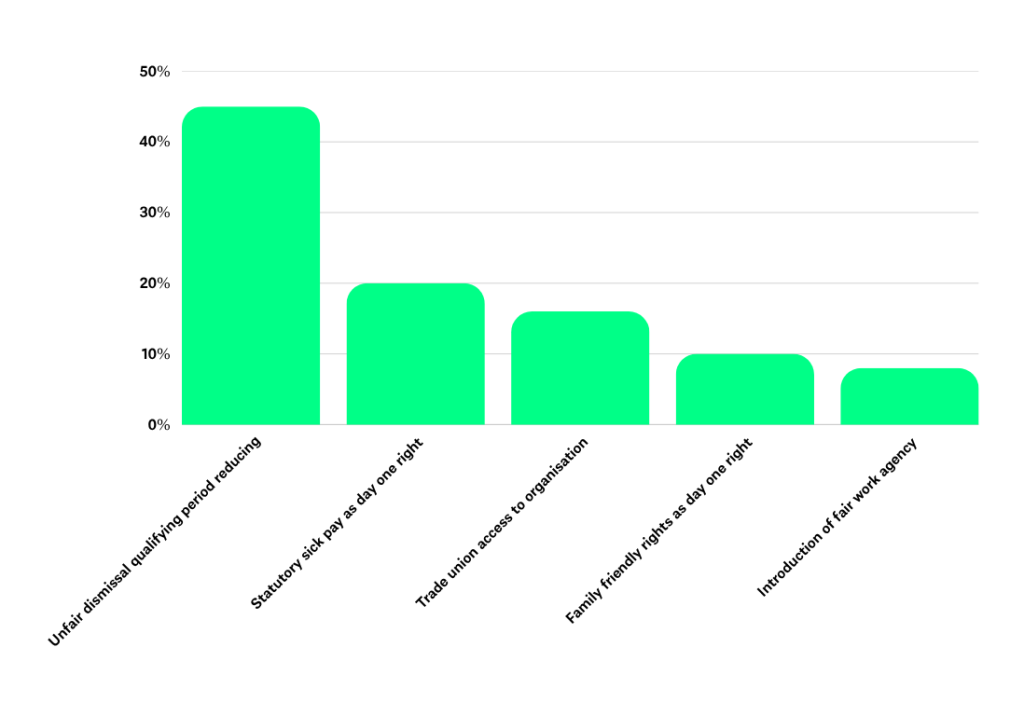
When asked about their biggest concerns, 45% of respondents identified the reduction of the unfair dismissal qualifying period from two years to six months as their primary concern. This was followed by day-one statutory sick pay rights (20%) and increased trade union access to organisations (16%).
The findings reveal a common theme: organisations are concerned about how new employment rights may influence behaviours, management practices and employee relationships.
The challenge is not to resist these changes. It is to ensure their organisation responds in a way that protects trust, maintains fairness and strengthens the work environment.
How organisations can prepare their work environment for the Employment Rights Act 2025
1. Unfair dismissal changes: avoiding a “hire slow, fire fast” culture
The reduction in the unfair dismissal qualifying period is one of the biggest concerns for organisations. While the intention is to increase employee protection, organisations must be careful that this does not unintentionally create a “hire slow, fire fast” mindset.
Without the right approach, businesses could see:
- Less willingness to recruit higher-risk or non-traditional candidates
- Greater scrutiny during the first months of employment
- Reduced patience for learning curves and settling-in periods
- More transactional employment relationships and a reduction in trust and loyalty
The answer is not to become more cautious. It is to respond differently.
Organisations should focus on strengthening manager capability, creating supportive probation processes and ensuring documentation supports effective conversations rather than replacing them.
The most successful organisations will redefine probation as a period of support, development and clarity, rather than simply a period of assessment.
2. Day-one statutory sick pay: creating a culture of trust and accountability
Changes to statutory sick pay have the potential to alter behavioural signals around absence. When organisations change the conditions around absence, they may see a greater need for consistent management approaches.
The challenge is finding the right balance between creating a culture of trust and maintaining accountability.
The goal should not be to control absence. It should be to create the right conditions where positive behaviours naturally happen.
Organisations can achieve this by:
- Setting clear expectations around attendance and well-being.
- Equipping managers to have open and honest conversations.
- Looking for patterns rather than isolated incidents.
- Maintaining consistency across teams.
- Creating a support-first approach to absence management.
3. Trade union access and employee voice: building a culture where people feel heard
Enhanced trade union access represents more than a procedural change. It reflects a wider shift in employee voice and influence.
For many organisations, particularly in the private sector, the biggest question is whether employees already feel heard.
Businesses that invest in strong communication, transparent leadership and meaningful employee feedback channels will be better prepared for the changes ahead.
Organisations should focus on:
- Strengthening existing employee voice mechanisms
- Creating forums for open and honest dialogue
- Building leaders who are comfortable listening and responding
- Addressing concerns early before they escalate
- Creating trust through greater transparency
Where people feel heard and issues are addressed early, the need for external intervention naturally reduces.
Is the Employment Rights Act 2025 more than a compliance challenge?
The Employment Rights Act 2025 is accelerating risk much earlier in the employee lifecycle and changing the signals that influence employee and management behaviour.
This means organisations cannot rely on policies alone.
The businesses that will adapt most successfully are those that invest in their managers, create consistency, build trust and make employee voice part of everyday culture.
The legislation may be the catalyst for change, but leadership will determine the outcome.
What the Employment Rights Act 2025 Means for Employers
The most successful organisations will not be those that simply react to legislative changes. They will be those that use this moment as an opportunity to strengthen their culture.
By investing in leadership capability, improving employee relationships and creating clear expectations, organisations can turn potential challenges into opportunities to build a more resilient work environment.
The Employment Rights Act 2025 should not be viewed purely as a legal obligation. It is a catalyst for organisations to reflect on how they recruit, support, manage and engage their people.
How can AAB help?
Preparing for the Employment Rights Act 2025 is about more than updating policies and procedures. It requires organisations to consider how they lead people, manage performance, support employee wellbeing and create environments built on trust.
At AAB, we help organisations move beyond compliance and take a proactive approach to the changes ahead.
Our People team specialists can support with:
- Reviewing HR policies, procedures and employee documentation to ensure they remain fit for purpose.
- Strengthening managers’ capability and confidence in having effective conversations.
- Reviewing recruitment, onboarding and probation processes to support fair and inclusive hiring.
- Developing practical approaches to absence management that balance support, consistency and accountability.
- Enhancing employee voice, communication channels and leadership behaviours.
- Identifying potential cultural risks before they become employee relations challenges.
The organisations that will adapt most successfully will be those that prepare early. By investing in their people, processes and leadership capability now, businesses can reduce risk and build stronger, more resilient workplace cultures for the future.
Whether your organisation needs support preparing for specific Employment Rights Act 2025 changes or it wants to understand the wider impact on its work environment, our People Services specialists are here to help. Please do not hesitate to get in contact with Louise McCosh, a member of our People team, or your usual AAB contact.
Jack O’Donnell
Sectors/Support
Non for Profit & Education.
A Desire to Help Businesses Succeed
“I was inspired to pursue a career at AAB after working in a fast-paced healthcare SaaS environment, where I was exposed to high-growth, data-driven decision-making.
I can apply the skills I have developed to businesses across different sectors and industries, helping them scale, adapt and succeed with confidence.”
Understanding Client Goals, Challenges & Progress
“My day-to-day role is varied. It includes supporting CFO engagements across a range of clients and helping solve complex commercial and financial challenges.
I also collaborate with internal teams across tax, audit and consulting to deliver integrated solutions, while attending regular client meetings to better understand their goals, challenges and progress.
By staying close to my clients, I can identify client needs, anticipate potential issues and ensure we continue to deliver value while supporting their wider objectives.”
Strong Relationships Built on Trust & Transparency
“Trust and transparency are key to building a strong relationship. I invest time upfront to get to know clients, understand their businesses and gain insight into their goals, challenges and priorities.
As a Director, the most satisfying part of working with clients is developing long-term relationships and becoming their trusted advisor. I also enjoy supporting clients through challenges and seeing the results of effective collaboration. It is especially rewarding to see clients achieve successful outcomes and grow their businesses.”
Navigating Challenges & Complex Problem Solving
“One of the most valuable lessons I’ve learnt is how to navigate rapid change in a growth SaaS environment.
Through that experience, I learned that strong relationships and clear communication are essential during times of uncertainty.
Challenges in my specialist area often involve problem-solving and simplifying complex financial information for clients in a way that is clear, relevant and actionable. Doing this well helps build trust quickly, especially with new clients, and supports successful, long-lasting relationships.”
Finance Goes Beyond Numbers
“A common misconception about my profession is that finance is only about numbers. I believe finance is just as much about the people behind the business. By building strong human relationships with clients, I can help businesses make better decisions.”
ADDING VALUE THROUGH COLLABORATION
“The most rewarding aspect of being part of my team and the wider AAB organisation is the strong team culture, which values collaboration and relationships. I also value the opportunity to build and maintain strong client relationships across a wide range of industries.
Relationship building, stakeholder management and strong analytical thinking are key strengths I bring to my role, enabling me to work closely with clients and colleagues to deliver meaningful outcomes.
As I continue to develop my career, I’m looking forward to building on these strengths through further specialisation in advanced data analytics, visualisation, CFO advisory and strategic partnering, ensuring I can continue to make a positive impact for clients.”
Mike Fenwick
SECTORS/SUPPORT
All sectors.
A CAREER BUILT ON ADVISORY
“I qualified as a Chartered Accountant, knowing that I wanted to move away from traditional audit and tax work and focus on advisory services instead. Corporate finance and grant advisory work appealed to me because it offered the opportunity to work closely with businesses, support strategic decision-making, and make a tangible difference to clients and their outcomes.
Over the course of more than 30 years working in corporate finance and advisory roles, I’ve developed strong analytical skills alongside broad commercial awareness across a wide range of industries. That experience allows me to support clients not only with the technical aspects of a transaction, but also with the wider commercial considerations that influence business decisions and long-term objectives.”
Delivering Commercial, Relationship-Led Advice
“My time is often spent speaking with clients and prospective clients, attending internal meetings, reviewing work produced by the wider Corporate Finance team, managing live mandates, and supporting ongoing transactions. A large part of the role also involves maintaining regular communication with clients and advisers to ensure projects continue progressing efficiently. And, of course, there is always plenty of coffee involved as well.”
Making a Positive Impact
“The most satisfying aspect of my role is achieving successful outcomes for clients and knowing that the advice and support we provide has genuinely made a difference. Transactions are often significant milestones for business owners, so being able to help guide them through those situations and reach a positive resolution is incredibly rewarding.
One recent example involved supporting a client who was in dispute with another shareholder, where communication had completely broken down and the future of the business was at risk. Working closely with all parties involved, we were able to negotiate an agreement that allowed the other shareholder to buy out our client, enabling the business to continue trading successfully. Helping clients navigate difficult situations like that and finding practical solutions is a huge part of what makes the role rewarding.
I also really value being part of a wider team where there is always support and expertise available when needed. Having experienced colleagues across different disciplines means we can collaborate effectively and provide clients with broader, more joined-up advice throughout a transaction or advisory process.”
Commitment & Dedication
“Building strong relationships with clients is one of the most important aspects of my role. I’ve learned over the years that becoming a trusted adviser is something that develops through open and honest communication, consistency, and understanding each client as an individual. Every business and every client is different, so it’s important to adapt your approach to each situation.
One thing I always try to do when building relationships with new clients is have conversations beyond just work. Getting to know someone personally, whether that’s discussing their weekend plans, holidays, or interests outside of business, it helps build stronger rapport and trust over time.”
MAKING A POSITIVE DIFFERENCE
“The greatest compliment I’ve received from clients is hearing that they appreciated the hard work and advice we provided and that we genuinely made a positive difference to their situation. For me, that is ultimately what advisory work is all about.”
A Compassionate Approach
“One of the biggest challenges early in my career was qualifying as a Chartered Accountant while balancing full-time work alongside studying during evenings and weekends. It required discipline, resilience, and commitment, but it also taught me the importance of hard work and adaptability, lessons that have stayed with me throughout my career.
Over time, I’ve also learned that managing client relationships is just as important as the technical side of advisory work. Every client communicates differently and responds differently under pressure, so understanding people and adapting your approach accordingly is essential. Building trusted relationships and maintaining honest communication, whether delivering good news or difficult conversations, is a fundamental part of helping clients effectively.”
Tackling the Challenges
“One of the biggest challenges within corporate finance advisory is managing people and expectations throughout transactions and advisory processes. Every client is different, and often the most important part of the role is maintaining strong communication, building trust, and helping clients navigate uncertainty confidently.
The profession is also evolving rapidly, particularly with the rise of AI and emerging technologies. Like many people within the industry, I’m interested in understanding how AI can help streamline some of the day-to-day administrative and transactional tasks, allowing advisers to spend more time focusing on strategic and relationship-led support for clients.”
MORE THAN CORPERATE FINANCE
“And finally, if there’s one misconception I’d love to challenge about the profession, it’s the idea that accountants are boring. Outside of work, I play guitar in a band, so there’s more to us than spreadsheets and numbers.”